India’s Solar Energy Revolution: PM Surya Sarovar Yojana and the Future of Renewable Energy
India is making significant progress towards a cleaner and more sustainable energy future. With rapid growth in solar power capacity, increased domestic manufacturing, and new government initiatives, solar energy is becoming a major pillar of the country’s renewable energy transition.
A major development is the approval of the Pradhan Mantri Surya Sarovar Yojana (PM-SSY), which aims to support 5,000 MW of floating solar photovoltaic projects integrated with energy storage systems.
In this article, we explore India’s solar energy growth, the key features of the new scheme, and the opportunities it could create for the renewable energy sector.
India’s Solar Power Growth
Over the past decade, India has significantly expanded its solar energy capacity. According to the Press Information Bureau (PIB), India’s installed solar capacity increased from approximately 3 GW in 2014 to 162.15 GW as of 30 June 2026.
This growth reflects the impact of government policies, infrastructure development, private-sector investment, and increasing adoption of solar energy across residential, commercial, industrial, and agricultural sectors.
Solar power is helping India strengthen its energy security, reduce dependence on fossil fuels, and move closer to its long-term climate objectives.
What Is the PM Surya Sarovar Yojana?
The Government of India approved the Pradhan Mantri Surya Sarovar Yojana on 31 July 2026.
The scheme focuses on developing floating solar photovoltaic projects with integrated energy storage systems. It is designed to increase renewable electricity generation while making productive use of existing water bodies.
Key Highlights of the Scheme
Floating solar capacity: Support for 5,000 MW of floating solar photovoltaic projects.
Energy storage: Storage systems with at least two hours of storage duration and 10,000 MWh of storage capacity.
Estimated budget: ₹5,070 crore.
Implementation period: Financial years 2026–27 to 2030–31.
Expected environmental impact: Approximately 10 million tonnes of annual CO₂ emission reductions.
Employment potential: An estimated 16,000–17,000 full-time-equivalent jobs.
Eligible regions: States and Union Territories across India.
The scheme is expected to increase India’s floating solar capacity from approximately 700 MW to 5,000 MW.
Source: Press Information Bureau, Government of India.
What Is Floating Solar Energy?
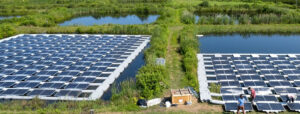
Floating solar energy refers to solar photovoltaic panels installed on floating structures placed on suitable water bodies, such as reservoirs and industrial ponds.
Unlike conventional ground-mounted solar projects, floating solar installations use water surfaces to generate electricity without requiring large areas of land.
Benefits of Floating Solar Projects
1. Efficient Use of Land
Floating solar projects can use suitable existing reservoirs and water bodies, reducing the need to acquire additional land for solar installations.
2. Increased Renewable Energy Generation
Floating solar systems can help expand solar power generation in regions where suitable land is limited.
3. Integration with Energy Storage
Combining solar power with battery or other eligible energy storage systems can help manage fluctuations in renewable electricity generation and support electricity supply during periods of high demand.
4. Reduced Carbon Emissions
Greater adoption of solar energy can help reduce dependence on fossil-fuel-based electricity and contribute to India’s climate objectives.
5. Opportunities for Domestic Manufacturing
The expansion of floating solar projects can create demand for photovoltaic modules, floating structures, electrical equipment, and energy storage technologies.
India’s Solar Energy Achievements in FY 2025–26
India’s renewable energy sector recorded substantial growth during the financial year 2025–26.
According to the PIB explainer, key achievements included:
India added 44.61 GW of solar capacity during FY 2025–26.
Solar module manufacturing capacity reached approximately 172 GW as of 31 March 2026.
Total non-fossil fuel installed capacity reached 283.46 GW.
Renewable energy capacity reached 274.68 GW.
These developments demonstrate the growing role of renewable energy in India’s electricity system.
The combination of large-scale solar projects, rooftop installations, agricultural solarisation, and domestic manufacturing is helping strengthen the country’s clean energy ecosystem.
Government Initiatives Supporting Solar Energy
India’s solar energy development is supported by several government initiatives designed to encourage investment, improve accessibility, and expand renewable electricity generation.
1. PM Surya Ghar: Muft Bijli Yojana
The PM Surya Ghar: Muft Bijli Yojana promotes rooftop solar adoption among eligible residential households.
The scheme aims to make rooftop solar more accessible and help eligible households reduce their dependence on conventional grid electricity.
Interested households should consult the official scheme portal to review current eligibility requirements, application procedures, and subsidy conditions.
Official website: https://pmsuryaghar.gov.in/
2. PM-KUSUM Scheme
The Pradhan Mantri Kisan Urja Suraksha evam Utthaan Mahabhiyan (PM-KUSUM) supports the adoption of solar energy in agriculture.
Its key objectives include supporting solar-powered agricultural pumps, decentralised solar power generation, and the solarisation of eligible grid-connected agricultural pumps.
The scheme can help eligible farmers access solar-powered irrigation solutions while reducing reliance on conventional electricity and diesel-powered systems.
Official website: https://pmkusum.mnre.gov.in/
3. Solar Park Scheme
The Solar Park Scheme supports the development of large-scale solar power projects by providing planned infrastructure and facilitating project development.
According to the PIB explainer, 54 solar parks with a combined approved capacity of 39,188 MW had been approved by February 2026.
Solar parks help developers access infrastructure and support the expansion of utility-scale renewable electricity generation.
4. Production-Linked Incentive Scheme for Solar Manufacturing
The government has also introduced measures to strengthen domestic solar manufacturing.
The Production-Linked Incentive (PLI) scheme for high-efficiency solar photovoltaic modules is intended to encourage investment in domestic manufacturing, strengthen the solar supply chain, and reduce import dependence.
Such initiatives can support the growth of India’s renewable energy manufacturing industry.
Opportunities for India’s Renewable Energy Industry
The expansion of solar power and floating solar projects could create opportunities across several areas of the renewable energy sector.
These include:
Solar photovoltaic module manufacturing.
Floating solar structures and installation systems.
Battery and energy storage technologies.
Solar project engineering, procurement, and construction.
Electrical infrastructure and grid integration.
Solar project operation and maintenance.
Renewable energy research and technology development.
As India’s solar capacity expands, businesses may find opportunities to participate in equipment manufacturing, project development, installation, and maintenance.
The scale of these opportunities will depend on project implementation, investment, demand, and applicable government policies.
The Future of Solar Energy in India
India has established ambitious renewable energy objectives as part of its broader climate and energy strategy.
The country’s commitments include achieving 500 GW of non-fossil-fuel electricity capacity by 2030 and reaching net-zero emissions by 2070.
Floating solar projects, rooftop solar installations, agricultural solarisation, energy storage, and domestic manufacturing can all contribute to this transition.
However, continued progress will depend on effective project execution, access to financing, reliable grid infrastructure, technological improvements, and the development of appropriate energy storage solutions.
The PM Surya Sarovar Yojana represents another step towards exploring India’s floating solar potential and integrating renewable energy with energy storage.
Conclusion
India’s solar energy sector is undergoing a major transformation, supported by expanding installed capacity, government initiatives, infrastructure development, and domestic manufacturing.
The Pradhan Mantri Surya Sarovar Yojana introduces an important focus on floating solar power and integrated energy storage. Its proposed capacity, budget, and implementation period highlight the government’s efforts to expand renewable electricity generation while making use of suitable existing water bodies.
As the sector continues to develop, solar energy is expected to remain an important part of India’s efforts to strengthen energy security, support economic opportunities, and build a more sustainable energy future.
Disclaimer: This article is an informational summary based on material published by the Press Information Bureau, Government of India. Scheme details, eligibility, implementation, and benefits should be verified through official government sources before making financial or business decisions.
Official Source
Press Information Bureau (PIB), Government of India: India’s Solar Energy Development and the PM Surya Sarovar Yojana.
Original source: https://www.pib.gov.in/PressNoteDetails.aspx?id=159397&NoteId=159397&ModuleId=3®=48&lang=1